
Stable Diffusion vs Midjourney
Compare a configurable open model ecosystem with a managed creative service by control, setup, privacy, repeatability, cost and workflow fit.
Updated September 5, 2026
On this page
Compare workflows, not gallery winners
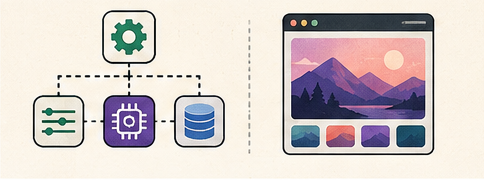
Stable Diffusion refers to a family and ecosystem of image models that can be used through hosted services or configured in self-managed tools. Midjourney is a managed creative service with its own interface, models and product decisions.
Both can produce strong images. The useful distinction is how much infrastructure and control you want around the generation process. Model versions, features and prices change quickly, so verify current provider documentation before making a long-term decision.
Stable Diffusion ecosystem strengths
A configurable workflow can offer control over model choice, hosting location, extensions, image dimensions, samplers, seeds and automation. Teams can build repeatable pipelines or run selected models on their own compatible hardware.
That flexibility creates responsibility. You must evaluate checkpoints, licenses, extensions, security, GPU requirements and update compatibility. Two interfaces using a similarly named model can produce different results because their defaults and added components differ.
Midjourney workflow strengths
Midjourney emphasizes a managed experience: the service chooses the model infrastructure and exposes creative controls through its product. This can reduce setup time and make visual exploration approachable for a team that does not want to maintain a generation stack.
The tradeoff is less control over hosting and internals. Current Midjourney versions and editing features evolve over time; its official version documentation is the right place to verify the active default.
Control and repeatability
If a production pipeline depends on exact versions, saved seeds, custom conditioning or automated batches, a controlled Stable Diffusion setup may fit better. Repeatability still depends on preserving the model, extensions and every relevant setting.
Midjourney offers parameters, image prompts and personalization within its supported workflow. It is well suited to guided exploration, but a managed service can change defaults and product behavior without matching a self-hosted version lock.
Privacy and deployment
Do not assume that “local” or “cloud” follows from the model name. Stable Diffusion can run locally or through a third-party API. Midjourney processing is managed by its service. Review where uploads are processed, how creations are visible, retention terms and organization controls for the specific plan and provider.
Sensitive client material may require an approved private deployment or a contract with defined data handling. Remove unnecessary metadata before uploading and avoid using confidential references in an unapproved service.
Cost is more than a subscription price
For a managed service, consider subscription limits, queue speed and team access. For self-hosting, include hardware, electricity, setup time, maintenance and failed experiments. Hosted Stable Diffusion APIs move infrastructure cost back into per-use pricing.
Compare the cost of the complete workflow: generating, selecting, editing, upscaling, storing and reviewing outputs.
Choose Stable Diffusion when
- deployment control is a requirement;
- you need custom models or extensions;
- the workflow must be automated through your own pipeline;
- your team can manage technical configuration;
- preserving a specific stack is valuable.
Choose Midjourney when
- fast visual exploration matters more than infrastructure control;
- a managed creative interface fits the team;
- you prefer product-level controls over assembling a stack;
- the current service terms and privacy model fit the project.
Run a fair evaluation
- Choose five real briefs, including one difficult edge case.
- Set a fixed time or cost budget for each workflow.
- Count usable outputs, not total images.
- Include correction and export time.
- Review licensing, privacy and team requirements.
- Record model and service versions with the result.
There is no permanent universal winner. Choose the workflow whose control, effort and operating model match the work you repeatedly need to deliver.